New
Žilina Region Has a Plan to Improve Air Quality
14. 09. 2026
 Air
On 28 August 2026, the District Office in Žilina published a new Air Quality Management Plan (AQMP) for the Žilina Region air quality zone. This strategic document establishes a comprehensive framework of measures aimed at reducing pollutant emissions and achieving consistently good air quality in the long term.
The AQMP was developed in response to exceedances of limit and target values for air pollutants, specifically particulate matter PM10 and PM2,5 and benzo(a)pyrene (BaP). The annual target value for BaP is 1 ng·m⁻³, yet monitoring stations have recorded persistently higher levels: 1.9 ng·m⁻³ in Žilina and 2.2 ng·m⁻³ in Ružomberok, with elevated levels also recorded in Oščadnica. Localised exceedances of PM10 and PM2,5 limits also occur. Modelling results indicate a risk of elevated particulate matter concentrations in several valleys and municipalities across the region.
Limit values for sulphur dioxide (SO₂), nitrogen dioxide (NO₂), carbon monoxide (CO) and benzene have not been exceeded in the Žilina Region.
Unfavourable Dispersion Conditions Make the Situation Worse
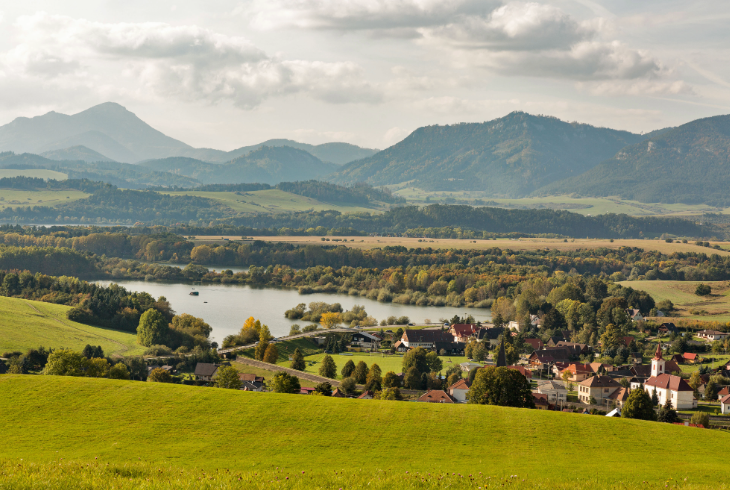
Air quality in the Žilina Region is significantly influenced by its varied terrain and the nature of emission sources. Its mountainous landscape, with deep and enclosed basins (Žilina, Turiec, Orava and Liptov), combined with frequent winter temperature inversions, creates unfavourable ventilation conditions. As a result, pollutants from local household heating sources can accumulate in the near-ground layer of the atmosphere during periods of poor dispersion.
The plan identifies residential heating with solid fuels, particularly firewood burned in inefficient stoves and boilers, as by far the most significant source of air pollution in the region. This sector is primarily responsible for high emissions of benzo(a)pyrene and particulate matter.
Road transport is another significant source of emissions. It contributes mainly to particulate matter and nitrogen oxide (NOx) emissions in larger towns and cities such as Žilina, Martin and Ružomberok, as well as near major transit routes D1, D3 and R3.
Industrial facilities, including Mondi SCP in Ružomberok, Dolvap in Žilina and Kia Slovakia, contribute mainly to SO₂ and NOx emissions. However, according to the plan, the overall contribution of industry to population exposure to basic air pollutants is lower than that of local household heating.
High-Risk Municipalities and Air Quality Management Areas
Based on an integrated assessment methodology, the Slovak Hydrometeorological Institute (SHMI) has classified municipalities in the Žilina Region into risk categories according to the severity of the threat posed by deteriorating air quality. Most municipalities in the Kysuce, Orava, Liptov, Turiec and Upper Váh regions fall into the highest risk categories, RS2 and RS3.
Municipalities classified as RS2
Babín, Belá, Beňadiková, Blatnica, Brezovica, Čičmany, Dolný Hričov, Ďanová, Ďurčiná, Fačkov, Galovany, Gbeľany, Horná Lehota, Horná Štubňa, Hruštín, Chlebnice, Ivachnová, Jablonové, Kamenná Poruba, Komjatná, Konská, Košťany nad Turcom, Kraľovany, Lazisko, Lietavská Svinná-Babkov, Liptovská Lúžna, Liptovská Osada, Liptovské Kľačany, Liptovské Revúce, Liptovský Michal, Lysica, Ľubochňa, Malatíny, Mošovce, Necpaly, Nededza, Nolčovo, Nová Bystrica, Oravská Poruba, Párnica, Podhradie, Povina, Príbovce, Pucov, Radoľa, Rajecká Lesná, Rajecké Teplice, Rudina, Rudinská, Sklabiňa, Sklené, Slovenské Pravno, Stará Bystrica, Strečno, Suchá Hora, Svätý Kríž, Švošov, Terchová, Trstené, Turčianska Štiavnička, Turčianske Teplice, Turie, Tvrdošín, Veličná, Vitanová, Vyšný Kubín and Zázrivá.
Municipalities classified as RS3, which also constitute Air Quality Management Areas (AQMAs)
Belá-Dulice, Beňadovo, Bobrov, Bobrovec, Breza, Bystrička, Bytča, Čadca, Čierne, Divina, Divinka, Dlhá nad Kysucou, Dlhé Pole, Dolný Kalník, Dolný Kubín, Dunajov, Dúbrava, Gôtovany, Hlboké nad Váhom, Hôrky, Hubová, Hvozdnica, Hybe, Jamník, Klin, Klokočov, Klubina, Kolárovice, Korňa, Kotešová, Kráľova Lehota, Krásno nad Kysucou, Krpeľany, Krušetnica, Kysucké Nové Mesto, Kysucký Lieskovec, Liesek, Lietavská Lúčka, Likavka, Lipovec, Liptovská Kokava, Liptovská Porúbka, Liptovská Štiavnica, Liptovské Sliače, Liptovský Hrádok, Liptovský Mikuláš, Liptovský Peter, Liptovský Trnovec, Lisková, Lokca, Lomná, Ludrová, Ľubeľa, Makov, Maršová-Rašov, Martin, Martinček, Medzibrodie nad Oravou, Mojš, Mútne, Námestovo, Nesluša, Novoť, Ochodnica, Olešná, Oravská Jasenica, Oravská Lesná, Oravská Polhora, Oravské Veselé, Oravský Podzámok, Oščadnica, Partizánska Ľupča, Petrovice, Podtureň, Podvysoká, Predmier, Pribylina, Rabča, Rabčice, Rajec, Raková, Rosina, Ružomberok, Sihelné, Skalité, Snežnica, Stankovany, Staškov, Sučany, Svederník, Svrčinovec, Štefanov nad Oravou, Štiavnik, Štiavnička, Ťapešovo, Teplička nad Váhom, Trstená, Turany, Turčianske Kľačany, Turzovka, Uhorská Ves, Varín, Vasiľov, Važec, Vavrečka, Veľké Rovné, Višňové, Vlachy, Vrútky, Východná, Vysoká nad Kysucou, Zákamenné, Zákopčie, Závažná Poruba, Zborov nad Bystricou, Zubrohlava, Žaškov and Žilina.
Measures Target Heating, Transport and Industry
The AQIP defines a set of priority, supporting and cross-cutting measures covering several areas:
Public awareness and heating inspections
One of the priority measures is information and awareness-raising (O.1). Awareness-raising events will be organised in high-risk municipalities before and during the heating season, alongside the dissemination of information on proper heating practices.
Another measure concerns inspections of heating appliances (V.7). Inspections to ensure compliance with proper combustion practices in households will be carried out following reports from residents, in cooperation with municipalities and the Slovak Environmental Inspectorate (SEI).
Boiler replacement and energy efficiency
The AQMP also provides for support for replacing high-emission boilers with low-emission and zero-emission heating sources (V.1).
Measure V.4 focuses on reducing the energy consumption of public and residential buildings, for example through insulation, window replacement and the use of renewable energy sources.
The programme also promotes district heating systems. In areas where a district heating network is available, new buildings will be required to connect to it.
Ecodesign requirements (V.6) are also included, meaning that only new small combustion appliances meeting strict ecodesign limits will be authorised.
Transport: bypasses, public transport and cycling routes
In the transport sector, the programme focuses on diverting transit traffic (D.1) through the construction of bypasses around towns and municipalities.
Measures D.3, D.4 and D.14 support public transport, the greening of vehicle fleets and the development of the Integrated Transport System of the Žilina Self-Governing Region. Plans include buses powered by electricity, CNG and hydrogen.
Attention is also given to non-motorised transport. Measures D.10 and D.11 include the construction of cycling routes, such as the Váh and Kysuce cycling routes, and the promotion of walking.
The plan also provides for the possibility of establishing low-emission zones (D.7), where access for high-emission vehicles would be restricted.
Industry and dust reduction
The AQMP provides for the introduction of Best Available Techniques (BAT) in industrial facilities, regular cleaning and watering of roads to remove winter road-gritting materials and reduce dust, as well as planting rows of trees and protective green belts to capture particulate matter.
Implementation Timeline
The AQMP measures are scheduled for implementation over the period 2025–2027. In 2028, the District Office in Žilina will review and evaluate the plan's implementation and prepare an update if necessary.
The plan was prepared by the District Office in Žilina, the Office of the Žilina Self-Governing Region, the Ministry of Environment of the Slovak Republic, the SHMI, the Slovak Environment Agency (SEA) and the Slovak Environmental Inspectorate (SEI), in cooperation with representatives of the municipalities concerned and other experts.
Local Air Quality Managers (AQMs) also played an important role. Their positions were established as part of the LIFE IP – Air Quality Improvement (Populair) project. Their role is to bridge the national and local levels and provide expert support to local authorities in planning and implementing effective measures.
The full Air Quality Management Plan for the Žilina Region air quality zone is available on the website of the District Office in Žilina and on the Enviroportal.